Wednesday, December 2, 2009

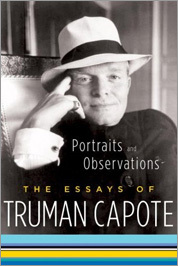
Portraits and Observations: The Essays of Truman Capote

It seems that in the past few years Truman Capote has transcended his status as a writer. The subject of two biopics (Capote and Infamous, released in 2005 and 2006, respectively), Capote also threw the famous Black and White Ball that was the topic of a recent book (Deborah Davis’ Party of the Century: The Fabulous Story of Truman Capote and His Black and White Ball). This recent Capote-mania has sealed his status as cultural icon, a position that isn’t dependent on his literary output, which gets a re-examination in Portraits and Observations: The Essays of Truman Capote.

Released in late 2007, the book is a collection of all the essays Capote ever published, some of which haven’t been released since their initial publication. The book seems to be an attempt to revive Capote’s reputation as a serious writer, and though hardly successful overall, some of the essays are a delight to read.

The chronological arrangement of Portraits and Observations traces the arc of Capote’s writing career. His body of work undergoes a distinct change around the time of In Cold Blood’s publication in 1966 — early pieces that are bright and promising give way to weary essays that miss their mark. Capote’s writing, like his life, peaked with In Cold Blood, a novel that drove him to drink and resulted in a steady decline in literary success.

The essay topics in Portraits and Observations are wide-ranging — everything from travel snapshots to meditations on celebrities to Capote himself comes under his discerning eye. His writing is descriptive and rich, and his slightly longer observations are the best examples of his nonfiction writing, suggesting that it generally takes more works for Capote to successfully present his subjects — despite believing himself to be a “spare” writer.

A snippet of “Self-Portrait” explains Capote’s seeming arrogance in his work:
Honestly, I don’t give a damn what anybody says about me, either privately or in print. Of course, that was not true when I was young and first began to publish. And it is not true now on one count — a betrayal of affection can still traumatically disturb me. Otherwise, defeat and criticism are matters of indifference, remote as the mountains of the moon.
A number of the 42 pieces are fine examples of what Capote can do, but there are also some that are simply frivolous — self-interviews with Capote give us insight into his psyche, but don’t do much to help his literary reputation. The same is true with brief snippets culled from a book he did with Richard Avedon — these “portraits” don’t really say anything about their subjects (on director John Huston — “He is a man of obsessions rather than passions, and a romantic cynic who believes that all endeavor, virtuous or evil or simply plodding, receives the same honorarium: a check in the amount of zero.”)

A later highlight is “Handmade Coffins,” Capote’s “nonfiction account of an American crime” from 1979, written as an interview and achieving the narrative voice that Capote seems to lose sight of as time passes. Other compelling pieces are “Lola,” a story about Capote’s pet raven, and the famous 1956 profile of Marlon Brando, whom Capote meets at a hotel in Kyoto.

Portraits and Observations begins with a look at New Orleans, where he was born, and leads into essays about a New York and Brooklyn that seem to be indistinguishable from the Southern city. The book closes with “Remembering Willa Cather,” which Capote wrote the day before his death in 1984, and touches on his relatives in New Orleans and Alabama. Each of his writings is imbued with an inescapable nostalgia for the South — despite calling the Big Apple his city, his writings suggest that the tormented writer never really left his bittersweet childhood behind.

This review was originally published in the Washington Blade.

Tuesday, December 1, 2009

The Boyfriend List

Todd, who is also known as my boyfriend, contributed this post on The Boyfriend List by E. Lockhart. To contribute a review or other literary musings to Attic Salt, e-mail atticsaltblog@gmail.com.

•••

A friend of mine (and contributor for The Misfits' Book Club) has been relentlessly throwing young adult fiction at me all year. Her most recent recommendation was the work of E. Lockhart, who's had her name on seven books in four years with an eighth due in 2010. Her 2005 debut was The Boyfriend List, which follows the exploits of high schooler Ruby Oliver as she suffers through a particularly heartbreaking sophomore year. This is the first in a series. If you told me last week I was going to get really into the four-book saga of a heartsick fifteen-year-old girl, I might've doubted you.

The book is structured against Ruby's list of the fifteen boys that have been, in one way or another, subject to her affections. Each gets his own chapter as Ruby dissects the relationships (or lack thereof) with her therapist. Sure, it sounds groan-worthy, but the novel, like any good work unfairly ghettoized onto that "young adult" shelf, quickly transcends its gimmickry thanks in part to expert plotting but mostly to Lockhart's uncanny ear for her young protagonist's voice.

Ruby is a dazzling creation. She makes coy use of footnotes and slang and has favorite words that she overuses. Ruby is the most lifelike narrator I've read in a while, flawed and selfish yet self-aware, in pursuit of self-improvement and validation. She's also profoundly sad and misunderstood, the victim of a social network that emphasizes labels and hierarchies and flourishes through texting and emailing but fails to promote any kind of real communication.

As with most high school-set stories of heartbreak, teenagers' inability to communicate honestly with each other is the thematic focus of The Boyfriend List. Ruby allows herself to be groped in a movie theater by a jock she barely knows (she discovers she kind of likes it); she responds to a sincere display of friendship by Boy #14 with a harmful and cruel "Fuck off." It's one in a string of devastating moments, leading me to desire throughout the story that I might sit Ruby down and impart some brotherly advice.

But the mistakes of adolescence are as easy to rue with perfect hindsight as they are to make, blindly, in the moment. The book is filled with astonishing set pieces that are far more exciting and suspenseful than I would've expected from a first-person coming-of-age story such as this. One breathless sequence revolves around the day the senior class is passing out roses and carnations ordered by friends, crushes, lovers and secret admirers among the underclassmen. Ruby waits all day in the hope that she will receive the right flowers, watching as friends count their stems like so much loose change. It unfolds like the final-act heist in a crime movie.

The Boyfriend List comes across as Mean Girls without the satirical sheen — the harsh truths imparted here with comic relief as opposed to the other way around — and it works just as well. In fact, there are several plot points which mirror that film. It leads up to a girls' room confrontation by two former best friends which poses Ruby on her knees, her lap soaking wet. As symbolism goes, it's pretty weighty for a YA book, which just goes to remind you that you can't ignore something just because you're not in the marketed-to demographic. I have a hundred other books to read, but the sequels to this are going to leap high in priority just as soon as I pay off my overdue fines at the Chicago Public Library.

Wednesday, November 25, 2009

Wednesday Poem: Leftovers, by Jack Prelutsky

This poem was sent in by Todd, who writes, "This is from an old children's book by Children's Poet Laureate Jack Prelutsky. Originally published in 1982, 'It's Thanksgiving!' was a staple of my childhood, and I was thrilled to track it down again recently with the guidance of several helpful bookstore clerks and the Internet. Turns out it's still in print, with a shiny new 'I Can Read!' edition from HarperCollins." To send in your favorite poem, e-mail: amy.cavanaugh@gmail.com.

Leftovers

Thanksgiving has been over
for at least a week or two,
but we're all still eating turkey,
turkey salad, turkey stew,

turkey puffs and turkey pudding,
turkey patties, turkey pies,
turkey bisque and turkey burgers,
turkey fritters, turkey fries.

For lunch, our mother made us
turkey slices on a stick,
there'll be turkey tarts for supper,
all this turkey makes me sick.

For tomorrow she's preparing
turkey dumplings stuffed with peas,
oh I never thought I'd say this —
"Mother! No more turkey... PLEASE!"

Friday, November 13, 2009

I Was Told There'd Be Cake

I've always been envious of authors like Bill Bryson or David Sedaris, who are able to put down vignettes about their lives in uproarious fashion. I'm sure if I thought long and hard enough, I could come up with several adventures from my own life that rival theirs, but I would never be able to do so with as much wit as they do.

Last weekend I picked up Sloane Crosley's I Was Told There'd Be Cake, which has been optioned by HBO for a small screen adaptation. The blurb on the front cover, by Jonathan Lethem, calls Crosley a "mordant and mercurial wit," though for me she never quite crosses into the realm of sheer hilarity. I went through a period of time where I would read Bryson on airplanes, to distract myself from the flight. To this day, I think they were the only times I ever laughed on a plane. But while Crosley wasn't as funny, she's a charming writer, and doesn't every twenty-something female in the U.S. in some way relate to every other twenty-something female?

From stories about her terrible first job out of college at a publishing house to being a bridesmaid for a woman she hasn't seen since high school, Crosley's essays are amusing and relatable (though no high school friend has yet asked me to don a pastel dress, thanks goodness). I Was Told There'd Be Cake is a quick read, and I'm looking forward to seeing what else Crosley writes in the future.

Thursday, November 12, 2009

Her Fearful Symmetry

I really do like a good ghost story now and then, and Her Fearful Symmetry, Audrey Niffenegger’s (The Time Traveler’s Wife) book, fits the bill. Set on the edge of Highgate Cemetery in London, Her Fearful Symmetry is the story of two pairs of twins, one set middle aged and living apart (one on London, one in Chicago) and the other set the daughters of the Chicago twin. When Elspeth, the London twin, dies, and requires that her nieces come live in her apartment without their parents for a year in order to inherit it, the events of the novel are set in motion.

When Valentina and Julia arrive in London, they begin to take over their aunt’s old life. They meet her neighbors, like Martin, an obsessive-compulsive crossword puzzle maker, who can’t leave his apartment, and Robert, Elspeth’s younger boyfriend, who is writing his doctoral thesis on Highgate. They’re also haunted by Elspeth, who declares — “a bad thing about dying is that I’ve started to feel as though I’m being erased. Another bad thing is that I won’t get to find out what happens next.” — and then sticks around to find out what does.

There’s the ghostly mystery of Elspeth’s haunting Robert and the twins, but the living mystery about what happened to cause a rift between Elspeth and her twin Edie is much more interesting. The answers lie in Elspeth's old journals, which she leaves to Robert, but he is unable to let himself read them.

The world and underworld in Her Fearful Symmetry are populated by truly awful, selfish characters — Julia won’t let Valentina finish college or attend design school so she can remain with Julia forever, Martin’s wife runs away to Amsterdam since she can’t handle his obsessions, Elspeth isn’t quite the friendly ghost she seems at first — but they manage to pull you in, much like they pull various characters into their webs of deceit.

About three-quarters through, the novel takes a rather morbid turn, but Niffenegger is a brilliant plotter and her text, which is fantastical from page one, gets even more so. She uses the supernatural in her books, but it never seems like it actually is, and Her Fearful Symmetry evokes 19th century sensation novels. Dark, eerie and often funny, Her Fearful Symmetry is meant to be read while curled up under a blanket on a cold winter's night.

Wednesday, November 4, 2009

The Girl Who Played With Fire

When I finished Stieg Larsson's The Girl With The Dragon Tattoo in August, I wanted to run right out and get its sequel The Girl Who Played With Fire, but I decided that I should wait a little while and read some other things first. I hate when books in a series start to blur together, and I wanted to keep these separate. I was able to dive right back in to the underworld of Swedish crime, since Larsson picks right back up where he left off.

The Girl Who Played With Fire revisits the main characters from the first book — Mikael Blomkvist, a journalist, Lisbeth Salander, a computer hacker, Blomkvist's colleagues at Millennium magazine, and Salander's former boss at a security company. Here, Millennium is working with a couple who are writing an exposé about sex trafficking in Sweden, and when they wind up dead, Salander's fingerprints are on the gun. When Salander's former guardian also ends up dead, there's a country-wide manhunt for her.

Larsson once again is an intricate plotter and master of suspense — he takes us into seedy worlds with kidnappings and has Salander and Blomkvist communicate via his hacked computer. And the books are high tech without being confusing for those of us who don't understand hacking.

I didn't think this book was quite as good as Dragon Tattoo, but that's partly because these were already characters we were familiar with, and we weren't introduced to any great new characters. But it's satisfying that Larsson picks up right where he left off and gives Salander and Blomkvist another rousing adventure.

I'm sure I'll read The Girl Who Kicked the Hornet's Nest, though I'm not going to run out and get it when it is published in the U.S. I want to give myself another little break, since these books are so satisfying they should be read sparingly.

Wednesday Poem: Sick, By Shel Silverstein

This poem was sent in by Mark. To send in your favorite poem, e-mail: amy.cavanaugh@gmail.com.

Sick

"I cannot go to school today,"
Said little Peggy Ann McKay.
"I have the measles and the mumps,
A gash, a rash and purple bumps.
My mouth is wet, my throat is dry,
I'm going blind in my right eye.
My tonsils are as big as rocks,
I've counted sixteen chicken pox
And there's one more--that's seventeen,
And don't you think my face looks green?
My leg is cut--my eyes are blue--
It might be instamatic flu.
I cough and sneeze and gasp and choke,
I'm sure that my left leg is broke--
My hip hurts when I move my chin,
My belly button's caving in,
My back is wrenched, my ankle's sprained,
My 'pendix pains each time it rains.
My nose is cold, my toes are numb.
I have a sliver in my thumb.
My neck is stiff, my voice is weak,
I hardly whisper when I speak.
My tongue is filling up my mouth,
I think my hair is falling out.
My elbow's bent, my spine ain't straight,
My temperature is one-o-eight.
My brain is shrunk, I cannot hear,
There is a hole inside my ear.
I have a hangnail, and my heart is--what?
What's that? What's that you say?
You say today is. . .Saturday?
G'bye, I'm going out to play!"

Thursday, October 29, 2009

Cover Candy: Pride and Prejudice

I am an avid reader of many book blogs, including the Baltimore Sun's Read Street. A nice mix of local and national coverage, the blog also does a weekly book giveaway — Freebie Friday. I entered two weeks ago (the question is always "what are you reading?"), and won a new Penguin Classics edition of Jane Austen's Pride and Prejudice, designed by by Coralie Bickford-Smith. The book arrived in the mail today - how pretty is it?

Wednesday, October 28, 2009

Wednesday Poem: La Belle Dame Sans Merci, by John Keats


This poem was sent in by Liz, who writes "I love John Keats so much and I've always been obsessed with this particular piece. I had read it a million times and didn't look too deep into the 'alone and palely loitering' until my junior year of college when my professor Dr. Grieco told me La Belle was a vampire. Blew my mind." To send in your favorite poem, e-mail: amy.cavanaugh@gmail.com.

La Belle Dame Sans Merci

Oh what can ail thee, knight-at-arms,
Alone and palely loitering?
The sedge has withered from the lake,
And no birds sing.

Oh what can ail thee, knight-at-arms,
So haggard and so woe-begone?
The squirrel's granary is full,
And the harvest's done.

I see a lily on thy brow,
With anguish moist and fever-dew,
And on thy cheeks a fading rose
Fast withereth too.

I met a lady in the meads,
Full beautiful - a faery's child,
Her hair was long, her foot was light,
And her eyes were wild.

I made a garland for her head,
And bracelets too, and fragrant zone;
She looked at me as she did love,
And made sweet moan.

I set her on my pacing steed,
And nothing else saw all day long,
For sidelong would she bend, and sing
A faery's song.

She found me roots of relish sweet,
And honey wild, and manna-dew,
And sure in language strange she said -
'I love thee true'.

She took me to her elfin grot,
And there she wept and sighed full sore,
And there I shut her wild wild eyes
With kisses four.

And there she lulled me asleep
And there I dreamed - Ah! woe betide! -
The latest dream I ever dreamt
On the cold hill side.

I saw pale kings and princes too,
Pale warriors, death-pale were they all;
They cried - 'La Belle Dame sans Merci
Hath thee in thrall!'

I saw their starved lips in the gloam,
With horrid warning gaped wide,
And I awoke and found me here,
On the cold hill's side.

And this is why I sojourn here
Alone and palely loitering,
Though the sedge is withered from the lake,
And no birds sing.

Painting by Frank Cadogan Cowper 'La Belle Dame Sans Merci'

Monday, October 26, 2009

Dead Until Dark

Emmyjean contributed this post on Dead Until Dark by Charlaine Harris. To contribute a review or other literary musings to Attic Salt, e-mail atticsaltblog@gmail.com.

•••

"'I have taken some night classes in psychology,' said Bill Compton, vampire."

This should give you an idea of what we're facing in Dead Until Dark, the first entry in Charlene Harris' Southern Vampire Mystery series.  Exposition so clunky it had me barking with laughter in public.  The incongruous pairing of would-be courtly language with present-day buzzwords.  And of course, vampires. Fucking vampires. 

When our grandchildren look back on the early 21st century mass cultural orgasm over vampires and ask us what that was all about, I'll have no good answer for them.  Sure, one could spin together a nice tale about fascination with vampires dating back to tales of Vlad the Impaler, told 'round a crackling Carpathian peasant's fire.  Bram Stoker would surely get a entry, trying to justify the vampire fascination as being part of a powerful literary tradition about the seductive power of evil.  

And then when I got to the Southern Vampire Mysteries, I'd blame them all on George W. Bush. 

This book, ostensibly about the collision between two exotic worlds, is in fact a celebration of their mutual mediocrity. Bon Temps, Louisiana is stuffed with unloveable losers.  There's our heroine Sookie, a waitress with few aspirations beyond sunbathing and slinging beers at Merlotte's. Her brother Jason is beautiful but proudly dumber than the sacks of asphalt he spreads as a road crew worker. Pity poor Arlene, beer slinger and single mother incapable of learning from her (many) encounters with bad men that she is not, in fact, an actual doormat. Sookie's lug of a friend from high school is still holding onto old football rivalries. Her Gran's old lady friends salivating over shared memories of the "Glorious War."  Even the vampires themselves, supposedly dripping in glamor and mystery, spend their nights at a bar in a Louisiana strip mall. Denizens of Bon Temps, undead or otherwise, aspire to nothing greater than their next beer or roll in the hay and/or coffin, yet they wear their stupidity, provincialism and prejudices as badges of pride. It's easy to imagine Sarah Palin referring to them as "real Americans." At least Twilight eventually sent its heroes to Italy. 

Speaking of Twilight and its feminist critiques, Dead Until Dark at least has the decency to grant our heroine a life outside of her vampire paramour.  Sookie may claim to be all boobs and no brains, but she is also a telepath (a "gift" or "curse" depending on the requirements of the scene).  That we would praise our narrator having experiences or thoughts outside of those immediately related to her boyfriend seems ridiculous, but in a post-Twilight world this makes her uniquely self-possessed.  Of course, it is Sookie's odd inability to read Bill's thoughts that draws her to him.  Because the key to a relationship is stony silences and unanswered questions. 

It bears mentioning that True Blood, the HBO series based on the Sookie Stackhouse novels, is everything the books want to be but fall short of. Cameras linger over titillating sex scenes that on the page cut away to a moonlit sky and wind in the trees; characters drawl with hilariously overdone Louisiana accents; the opening credits teem with images of Southern Gothic tropes like menacing Klan members and tent revivals. Where the Skinemax-inspired show prances about with tongue firmly in cheek, the amatuerish writing of its source material comes off as cut-rate fanfic. True Blood is lusty, campy, and in on the joke where Dead Until Dark remains, well, bloodless.