 “this is why we call people exes, i guess – because the paths that cross in the middle end up separating at the end. it’s too easy to see an X as a cross-out. it’s not, because there’s no way to cross out something like that. the X is a diagram of two paths.” [sic].
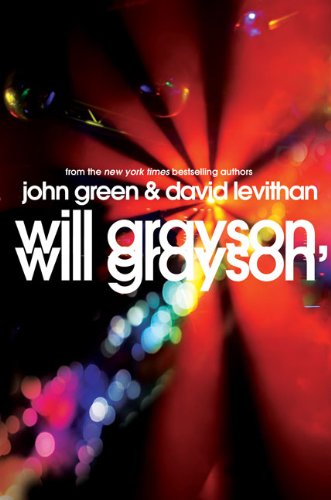
So says Will Grayson, partial narrator of the new dual-authored novel Will Grayson, Will Grayson (out on Tuesday), making rare use of capitalization. Though he may not realize it, Will Grayson is describing the structure of the novel, which follows the X-like paths of two teenagers who have the same name.
Will Grayson is co-written by reputable YA authors John Green and David Levithan, each writing half the novel from the perspective of one Will Grayson. This is similar to Levithan’s work with Rachel Cohn in Nick and Norah’s Infinite Playlist and Naomi and Ely’s No Kiss List. The gimmick works here like never before, as the Wills collide together in a perfect storm of adolescent identity crises.
Levithan’s Will is a perpetually withdrawn closeted gay kid with a regiment of antidepressants and a lonesome, Pride and Prejudice-obsessed single mother. Green’s Will is similarly withdrawn although he fits into a less oppressive social caste than Levithan’s. Green’s Will withdraws by conscious choice, making two rules for himself: “1. Don’t care too much. 2. Shut up.”
Will has created this ‘seen and not heard’ defense mechanism in the social fallout of having publicly supported, in writing, his best friend’s open homosexuality. That friend is Tiny Cooper, ironically nicknamed (and flamingly gay) giant football player. Tiny will be the node at which the two Will Graysons intersect and also the novel’s thematic nexus.
Tiny is the rare openly gay high schooler; in the hallways he flaunts his homosexuality in a way that not only wears down the homophobia of his classmates but also wears down the patience of his best friend Will. When Tiny later gets close to the other Will Grayson, the moody, insular one who thinks in lowercase, he forces both Wills, already reflexively questioning themselves, to come up with some answers.
Within their contemporary suburban setting, Green and Levithan make expert use of the gadgets and Internets that keep teenagers (and adults, when you get right down to it) from making connections with others. It’s poignant and heart-wrenching to witness these poor kids desperately constructing extensions of themselves via Facebook, text message and chat room, but neglecting to reinforce the foundations of their actual physical and mental selves. At one crucial moment, a character stumbles upon an emotional truth by tapping out an e-mail on his cell phone that he will never send.
The novel’s most sweeping example of this is the arc of Tiny’s original musical, Tiny Dancer, which goes from page to stage over the course of the book. The musical is an overhyped epic autobiographical tale of growing up out and proud, but of course there’s more to Tiny’s self-possession than pride. The play, like most of the characters’ actions, represents a desperate existential plea for validation.
Tiny forces the Wills into a love triangle that contrasts romantic love with platonic by questioning which is easier to fall in to or out of. Upon meeting each other, the two Will Graysons must confront their own demons head on: not only are you not very good at being you, but suddenly you have to compete. Who are you, really, if you aren't even the only one who's you?
The solution they find — that the self must be defined both in terms of the people who love you but also in terms of, you know, yourself — may be a little contrived and easy for a group of humans as realistically flawed as these, but it’s also touching and, more importantly, instructive. The tale of two Will Graysons becomes a fable about the essential need to be okay with yourself before you can be okay with other people. I wish I’d had this book when I was in high school.
•••••
Todd Detmold is the proprietor of My Favorite Gum Commercial. Were he ever to confront a second Todd Detmold, the universe would likely collapse in upon itself in a cloud of passive aggression. To contribute a review or other literary musings to Attic Salt, e-mail atticsaltblog@gmail.com.


 Posts
Posts