Showing posts with label essays. Show all posts

Monday, December 7, 2009

Eating the Dinosaur

Todd contributed this post on Eating the Dinosaur by Chuck Klosterman. To contribute a review or other literary musings to Attic Salt, e-mail atticsaltblog@gmail.com.

•••

According to the copy on the back of Chuck Klosterman's new collection of essays — copy he presumably wrote himself — the "larger theme" of Eating the Dinosaur is "something about reality… most of the core questions dwell on the way media perception constructs a fake reality that ends up becoming more meaningful than whatever actually happened."

Klosterman is a pop culture pundit. He makes his living writing about and discussing various aspects of our modern world that range from politics and the Internet to Weezer frontman Rivers Cuomo and the television show Survivor. This is his sixth book, after two memoirs, an anthology of previously published journalistic essays and interviews, a novel and another collection of original essays. I've been following the guy for quite a while now and my opinion of him used to rise and fall by the extent to which I agreed with his opinions on a given film or band.

In Eating the Dinosaur, Klosterman has come into his own as a philosopher for the modern age. While he's previously been indispensible as a thinker and talking head in the consumption and analysis of popular culture, I think he has advanced now to a point where I would say his work is finally "Capital I" Important.

There is an overarching theme here, as stated, that was missing in his previous book of essays, Sex, Drugs and Cocoa Puffs. From the quoted description, you'd think he might just be discussing cable news and the Internet. However, while those certainly come into play here, they are but two of several topics that get strung together in surprising and confounding theses that actually affect a deeper and more complicated engagement with the pervasive culture in which we all have no choice but to inhabit.

In "Oh, the Guilt," Klosterman draws a lengthy comparison between Kurt Cobain in his final days as a rock star and David Koresh, leader of the Branch Davidian sect that was burned alive at Waco. Both men, he posits, were victims of an iconography that they only kind-of asked for and couldn't handle, emotionally. In the final section of the book, "FAIL," he issues a lengthy treatise on the prophetic nature of Ted Kaczynski's manifesto "Industrial Society and Its Future." Klosterman ties this into a feeling, reflected throughout the book, that in the Information Age we have lost control of our technologies and are now slaves running along a superhighway with a minimum speed limit far beyond our reach.

But it's not all as heavy-handed as that summary might imply. At his most serious, Klosterman drops references to pop music and reality television and keeps the tone light and digestable. He also never preaches. As I closed the book I was left with a definite sense of paranoia about the world I live in, but simultaneously my fears were assuaged by Klosterman's optimism and intellectual bonhomie.

At the same time, what makes the book so important is that any conclusions reached about society or popular culture will vary wildly from reader to reader. Klosterman isn't afraid to say "I don't know;" he's merely in the business of asking questions that need to be asked. It's easy to write an essay about the inherent stupidity of the sitcom laugh track; Klosterman asks us to consider the laugh track's relationship to an American's daily dosage of 'courtesy laughter,' and what it says about us as a people that the device perseveres, like a cockroach, to this day.

I generally try to promote discussion of those aspects of our popular culture that generally go ignored by the intellectuals. The high-brow must consider the low-brow, and vice-versa. Survivor may be a bread and circus show for middle Americans condescended by coastal liberals, but it's also a thrilling examination of rat-in-a-maze sociology. At the same time, left-wing hero Ralph Nader must be considered as the swing of the 2000 election that sent America down the rabbit hole. We must consider all sides; we are all, in fact, in this together. In the simple battle to keep a conversation going, Klosterman is my brother-in-arms. Fight the good fight, man.

Wednesday, December 2, 2009

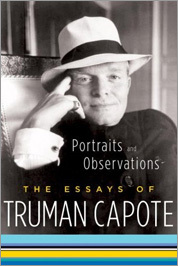
Portraits and Observations: The Essays of Truman Capote

It seems that in the past few years Truman Capote has transcended his status as a writer. The subject of two biopics (Capote and Infamous, released in 2005 and 2006, respectively), Capote also threw the famous Black and White Ball that was the topic of a recent book (Deborah Davis’ Party of the Century: The Fabulous Story of Truman Capote and His Black and White Ball). This recent Capote-mania has sealed his status as cultural icon, a position that isn’t dependent on his literary output, which gets a re-examination in Portraits and Observations: The Essays of Truman Capote.

Released in late 2007, the book is a collection of all the essays Capote ever published, some of which haven’t been released since their initial publication. The book seems to be an attempt to revive Capote’s reputation as a serious writer, and though hardly successful overall, some of the essays are a delight to read.

The chronological arrangement of Portraits and Observations traces the arc of Capote’s writing career. His body of work undergoes a distinct change around the time of In Cold Blood’s publication in 1966 — early pieces that are bright and promising give way to weary essays that miss their mark. Capote’s writing, like his life, peaked with In Cold Blood, a novel that drove him to drink and resulted in a steady decline in literary success.

The essay topics in Portraits and Observations are wide-ranging — everything from travel snapshots to meditations on celebrities to Capote himself comes under his discerning eye. His writing is descriptive and rich, and his slightly longer observations are the best examples of his nonfiction writing, suggesting that it generally takes more works for Capote to successfully present his subjects — despite believing himself to be a “spare” writer.

A snippet of “Self-Portrait” explains Capote’s seeming arrogance in his work:
Honestly, I don’t give a damn what anybody says about me, either privately or in print. Of course, that was not true when I was young and first began to publish. And it is not true now on one count — a betrayal of affection can still traumatically disturb me. Otherwise, defeat and criticism are matters of indifference, remote as the mountains of the moon.
A number of the 42 pieces are fine examples of what Capote can do, but there are also some that are simply frivolous — self-interviews with Capote give us insight into his psyche, but don’t do much to help his literary reputation. The same is true with brief snippets culled from a book he did with Richard Avedon — these “portraits” don’t really say anything about their subjects (on director John Huston — “He is a man of obsessions rather than passions, and a romantic cynic who believes that all endeavor, virtuous or evil or simply plodding, receives the same honorarium: a check in the amount of zero.”)

A later highlight is “Handmade Coffins,” Capote’s “nonfiction account of an American crime” from 1979, written as an interview and achieving the narrative voice that Capote seems to lose sight of as time passes. Other compelling pieces are “Lola,” a story about Capote’s pet raven, and the famous 1956 profile of Marlon Brando, whom Capote meets at a hotel in Kyoto.

Portraits and Observations begins with a look at New Orleans, where he was born, and leads into essays about a New York and Brooklyn that seem to be indistinguishable from the Southern city. The book closes with “Remembering Willa Cather,” which Capote wrote the day before his death in 1984, and touches on his relatives in New Orleans and Alabama. Each of his writings is imbued with an inescapable nostalgia for the South — despite calling the Big Apple his city, his writings suggest that the tormented writer never really left his bittersweet childhood behind.

This review was originally published in the Washington Blade.

Friday, November 13, 2009

I Was Told There'd Be Cake

I've always been envious of authors like Bill Bryson or David Sedaris, who are able to put down vignettes about their lives in uproarious fashion. I'm sure if I thought long and hard enough, I could come up with several adventures from my own life that rival theirs, but I would never be able to do so with as much wit as they do.

Last weekend I picked up Sloane Crosley's I Was Told There'd Be Cake, which has been optioned by HBO for a small screen adaptation. The blurb on the front cover, by Jonathan Lethem, calls Crosley a "mordant and mercurial wit," though for me she never quite crosses into the realm of sheer hilarity. I went through a period of time where I would read Bryson on airplanes, to distract myself from the flight. To this day, I think they were the only times I ever laughed on a plane. But while Crosley wasn't as funny, she's a charming writer, and doesn't every twenty-something female in the U.S. in some way relate to every other twenty-something female?

From stories about her terrible first job out of college at a publishing house to being a bridesmaid for a woman she hasn't seen since high school, Crosley's essays are amusing and relatable (though no high school friend has yet asked me to don a pastel dress, thanks goodness). I Was Told There'd Be Cake is a quick read, and I'm looking forward to seeing what else Crosley writes in the future.