Happy Friday! Some miscellaneous bits:
• Attic Salt's editor covers D.C.-area book news for the Washington City Paper, so if you live in D.C. be sure to bookmark this page.
• The Jane Austen Challenge kicks off on Monday, so use this weekend to pick up a copy of Sense and Sensibility if you haven't already.
• Follow Attic Salt on Twitter for even more book news and fun links that don't make their way on to this site.
Friday, February 26, 2010


Wednesday, February 24, 2010
Review: Talking About Detective Fiction
 In Talking About Detective Fiction
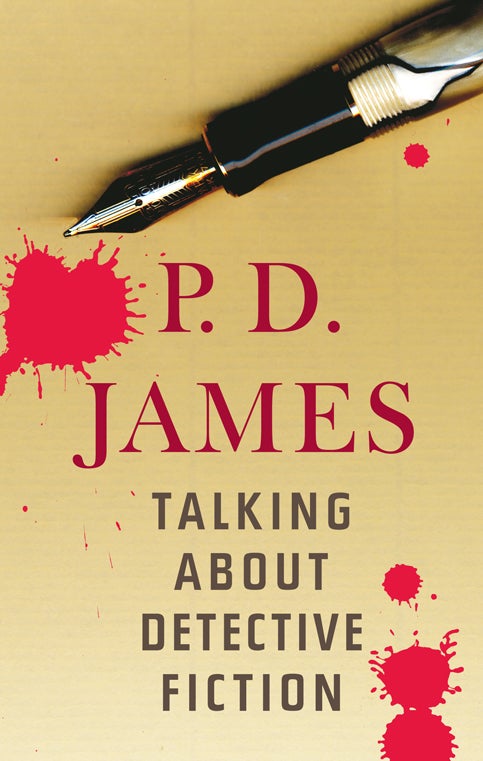
 , P.D. James deftly explores the history of detective novels in both Britain and America, and posits that contemporary unrest will lead to a renewal of interest in detective writing. James roots the genre in Wilkie Collins’ 1868 The Moonstone and traces its growth through the years, concentrating on the “The Golden Age” of detective writing – the period between the World Wars – and discussing the women writers she feels were instrumental in establishing the genre’s current reputation.
James is perhaps the best person to write a history of the genre that she’s been so prolific in, and she folds in her own writing experiences – important, since leaving out her own contributions would be an oversight. She does so casually, never making her work the focus of any one section, and explains why certain facets of the genre – such as never writing in first person, since that way readers only get one perspective of the case – work for her.
The most famous detective in literature, Sherlock Holmes, shares a chapter with G.K. Chesterton’s Father Brown, and James presents Holmes as the “unique, the unchallenged Great Detective, whose brilliant deductive intelligence could outwit any adversary, however cunning, and solve any puzzle, however bizarre.”
James discusses Arthur Conan Doyle’s publication history, and explores the relationship between Holmes and Watson, noting that the Watson prototype — “the stupid friend of the detective… should be slightly, but no more than slightly, less intelligent than the average reader, and his thoughts should not be concealed” — doesn’t appear in as many detective novels as he once did. (You should also go read this great article on Holmes’ London that appeared in the January issue of Smithsonian Magazine)
She also notes Agatha Christie’s popularity while downplaying her effect on detective novels:
Agatha Christie hasn’t in my view had a profound influence on the later development of the detective story. She wasn’t an innovative writer and had no interest exploring the possibilities of the genre. What she consistently provided is a strong and exciting narrative, the challenge of a puzzle, an accommodating and accessible style and original detectives in Poirot and Miss Marple, whom readers can encounter in book after book with the comfortable assurance that they are meeting old friends.James later writes that “rereading a selection of her stories to affirm or modify my existing prejudices I found some lost even their ability to keep me reading. Others surprised me by being both better written and more ingeniously puzzling than I remembered." James prefers the work of writers like New Zealander Ngaio Marsh, who was deft at characterization.
After she presents Collins, Edgar Allan Poe and Conan Doyle as innovators, James traces how more contemporary authors have put their own spin on things – Dashiell Hammett and Raymond Chandler wrote hard-boiled novels with a distinctly American flavor, and Dorothy L. Sayers wrote about murder in a new, realistic way – but she fails to identify any detective novelist from the last 50 years who has had a profound influence on the genre. While science has demanded an update in the way detectives use DNA evidence, it hasn’t changed the way they locate suspects. Detective novelists may have updated and adapted the formula for their time and country, but no one has stormed in and upended the genre.
James believes that an interest in detective fiction is on the rise, as “its popularity suggests that in the twenty-first century, as in the past, many of us will continue to turn for relief, entertainment and mild intellectual challenge to these unpretentious celebrations of reason and order in our increasingly complex and disorderly world.”
Talking About Detective Fiction is a quick read and a nice, historical look at the genre for those who are familiar with it or want to know where to start. James doesn’t unearth anything new or groundbreaking, but she shows that despite the changes in technology, society and law enforcement in the last century, a quaintness remains in the detective novel, and it can survive because it offers a sense of comfort and escape for readers.
Monday, February 22, 2010
Attic Salt's Jane Austen Challenge

Reading Jane Austen's six novels is one of my 2010 reading resolutions. Now that Sense and Sensibility has arrived in the mail from Powell's Books, I'm ready to start reading. But first I'm going to lay out the parameters of my project, in case anyone wants to join in, and so you're aware that there is going to be a lot of Austen content on Attic Salt in the coming months. But don't worry, it won't be all Jane, all the time — this project doesn't mean that I won't be posting other reviews or content while the Jane Austen Challenge is going on. In fact I have a very exciting new series I'm getting ready to launch soon!
The project was borne of the fact that of Austen's novels, I have only read Emma previously, and after seeing A Woman's Wit: Jane Austen's Life and Legacy at the Morgan Library and Museum, I'm inspired by the effect Austen's work has had on so many writers. And yes — I am aware that reading all of Jane Austen's novels is the subject of a novel, The Jane Austen Book Club (which I haven't read) and a movie of the same name (which I have seen — unfortunately).
I will be reading Austen's books in the order they were published: Sense and Sensibility (1811), Pride and Prejudice (1813), Mansfield Park (1814), Emma (1815), Northanger Abbey (1817) and Persuasion (1817). I'm planning for a month to read each novel, and I'll make a schedule for each book.
• Sense and Sensibility, March
• Pride and Prejudice, April
• Mansfield Park, May
• Emma, June
• Northanger Abbey, July
• Persuasion, August
I am reading the new Penguin Classics hardcover edition of Sense and Sensibility, and introduction and appendix aside, there are 349 pages of text. This comes in at less than 100 pages each week, which means there's still time to read other material as well (as we saw from Infinite Summer, when I undertake a major reading project, I need to be able to read other books on the side).
The Schedule
Saturday, March 6 - Chapters 1-13
Saturday, March 13 - Chapters 14-22
Saturday, March 20 - Chapters 23-34
Saturday, March 27 - Chapters 35-44
Wednesday, March 31 - Chapters 45-50
Saturday, March 6 - Chapters 1-13
Saturday, March 13 - Chapters 14-22
Saturday, March 20 - Chapters 23-34
Saturday, March 27 - Chapters 35-44
Wednesday, March 31 - Chapters 45-50
And this kind of thing is only any fun if other people participate as well — I've already convinced Todd (who also made the cute banner up at the top of this post) to join in, and a few other friends have also expressed interest. You're all invited to read along with us, joining for all six or as many as you want. I'll be posting on different topics as I progress through each novel, and I'll write a longer recap post at the end of each book. I'd also welcome guest posts on any topic related to Austen.
I think that's about it, and I'll see you back in this space to get started next Monday. Anyone in?
Friday, February 19, 2010
Review: When You Reach Me
 When I was younger I used to try to read my way through the list of Newbery Award winning books, and I've probably read about half of the winners. In recent years, though, I've fallen off — the last I read was Kate DiCamillo's 2004 The Tale of Desperaux. But the buzz about Rebecca Stead's 2010 Newbery winning book, When You Reach Me
 , encouraged me to pick up the title, which has parallels and references to another Newbery winner, Madeleine L'Engle's 1963 winner, A Wrinkle in Time
 .
.Set in 1979 Manhattan, When You Reach Me is about Miranda, a sixth grader who lives in a dodgy neighborhood with her single mom. One day Miranda finds a strange note that seems to come from the future, and the letter writer asks Miranda to tell him about her life so she can help prevent a tragedy. Suddenly unusual events start happening: Miranda's best friend stops talking to her after he gets punched on the street, Miranda's mother earns a spot on $20,000 Pyramid, the spare apartment key disappears, Miranda makes some new friends (and gains a crush), and an eccentric "laughing man" takes up residence on her corner. Any one of these events would be monumental to a 12-year-old, but combine them, and Miranda is on one heck of a ride.
So are readers — the more I think about it, the more I like this novel. Miranda's voice and narrative style remind me of an older version of Opal from Because of Winn-Dixie: inquisitive and friendly, she's very likable.
When You Reach Me jumps around temporally at the beginning, mirroring the theme of time travel that runs throughout the book, which means that the plot is revealed slowly at first and you feel nearly as disoriented as Miranda. But as the book goes on you realize that past, present and future are all happening at once and that Stead's work is that expertly plotted.
Stead sets When You Reach Me within a few blocks — the action takes place in Miranda's apartment building, at school, and at Miranda's part-time job — a small world, but a world large and full of possibility for a 12-year-old. It's also set 30 years in the past; it feels like of retro, like From the Mixed-Up Files of Mrs. Basil E. Frankweiler or Harriet the Spy, which were actually written decades ago. So it's also part-historical novel, and kids can see what it was like to grow up without the Internet and those little gadgets adults carry around constantly.
All these aspects make When You Reach Me a great novel for kids, but it is just as enjoyable for adults. And you can read it in an afternoon — how many great books geared towards adults can you say that about?
Monday, February 15, 2010
Review: On Beauty
 I didn't read E.M. Forster’s Howards End, a novel about the relationships between different social classes during turn of the (20th) century England, before opening Zadie Smith’s On Beauty, an homage to and riff on Forster's work. But I quickly realized you don't have to catch all the parallels between the two works to appreciate On Beauty, an elegant and funny satire about two academic families – the Belsey and Kipps clans – and their tragic affairs.
Published in 2005, On Beauty was shortlisted for the Man Booker Prize that year, and while it seems to be Smith's debut novel, White Teeth, that endures in popularity, On Beauty is a much more confident effort. Set in Wellington, a fictional suburb of Boston, On Beauty concerns art history professor Howard Belsey, a white Englishman married to Kiki, an African-American nurse and the novel's moral center. The couple lives with their three children, newly-religious Jerome, overachiever Zora, and Levi, a high school student striving to break free of the constraints of the liberal elite and develop street cred.
Their counterparts are the outspoken and reactive Kipps family, headed by art history professor and cultural critic Monty Kipps, a black Englishman by way of the Caribbean. Kipps' unusual wife Carlene and beautiful daughter Victoria develop relationships with members of the Belsey family, creating both inter- and intrafamilial strife.
Beginning with an ill-fated affair between Jerome and Victoria, which sets off a chain reaction of relationships and wished-for relationships between all the main characters, On Beauty is an examination of love and lust — and equally, between the demise of love and lust — glossed over with a satirical sheen. The affairs here aren't passionate or fulfilling, since each affair compensates for something missing in the lives of its participants and often destroys stable relationships with others in the process; the affairs themselves are fleeting, their impacts are not. By focusing on the internal effects of the collapse of Kiki and Howard's 30-year marriage, Smith rightly grants more weight to, essentially, the only acceptable pairing (I can't spoil who actually gets together) in the whole novel.
Beyond the plethora of romantic and sexual relationships depicted here, Smith engages in a minor study of race, partly through the character of Carl, a boy from a neighboring town and an aspiring rapper/poet, the object of desire for many of the main characters, and partly through the mixed race Belsey children, who wonder the extent to which their race defines them.
Smith has a lot to say on these topics, and much of it is great. My problem with On Beauty is that it's simply too long — my copy ran 464 pages — and many scenes could do with a bit of streamlining. Despite that, On Beauty is a reminder that Smith is one of the great novelists of our time.
Wednesday, February 10, 2010
Bookman's Alley in Evanston, IL
Todd and I recently visited the used bookshop Bookman's Alley in Evanston, Illinois. For those unfamiliar with the charming shop, it's pretty much like a museum inside, with interesting objects — armor, old military uniforms, paintings, gorgeous old desks that I coveted — filling every surface and corner.

Bookman's Alley isn't the sort of place to snag a $2 used paperback, but rather a place to go if you're able to drop $850 on a set of first edition Nathaniel Hawthorne novels. So while we left without buying anything, it was still fun to sift through boxes of old postcards and posters, try on old hats, and look at beautiful first editions.


Bookman's Alley isn't the sort of place to snag a $2 used paperback, but rather a place to go if you're able to drop $850 on a set of first edition Nathaniel Hawthorne novels. So while we left without buying anything, it was still fun to sift through boxes of old postcards and posters, try on old hats, and look at beautiful first editions.


Me leafing through Joseph Conrad's Victory, a novel that is sitting unread on my window shelf in D.C.
Tuesday, February 2, 2010
Out of Print Literary T-Shirts

My favorite two are Moby-Dick and The Hound of the Baskervilles, but click here to see the others, including Tales of the Jazz Age and The Master and Margarita.

Thursday, January 28, 2010
"The Cults of the Famous and the Dead"

•••
I finally got around to Audrey Niffenegger’s oft-recommended The Time Traveler’s Wife this week. By coincidence, this immediately followed the new Joshua Ferris, The Unnamed, making two-in-a-row post-White Noise novels about the effects of debilitating disease on otherwise loving and fruitful marriages. What I’m left with is that Ferris knows his pathos, while The Time Traveler’s Wife gets added to the list of wildly popular entertainments that make me feel like I’m living alone in a nation of people speaking a different language.
What do people see in The Time Traveler’s Wife? I’d love to know. Is it the sense of accomplishment at getting through a 500-plus-page book that spells everything out in the first 50? Is it the on-the-nose statement of themes? Niffenegger treats book-club hot topics such as “free will v. predestination” and “true love v. adversity” with all the nuance and subtlety of a slasher flick serial killer opening wounds with a large kitchen knife. “…sometimes you tell me something and I feel like the future is already there, you know?” muses the 13-year-old Clare to the 36-year-old Henry, her future husband, early in the book. “Like my future has happened in the past and I can’t do anything about it.” Henry replies, “That’s called determinism. It haunts my dreams.” Much later, when adult Clare has taken up painting pictures of birds in cages, Henry wins the lottery for her. Hooey.
In Niffenegger’s unwillingness to toy with her “chrono-impairment” premise, she sets up an internal logic where the entire story is laid out in the first 50 pages of the book. She uses the rest of her ink telling you things you already know, throwing around dramatic miscarriages that are all the more unbearable for the knowledge that Henry and Clare will, in fact, have a beautiful, perfect, time-traveling daughter. This is a love story wrought with tension but devoid of mystery or possibility. The dual narrators’ extreme angst is borne of a happy and loving relationship that actually lasts quite a bit longer than most (from Clare’s age 6 to age 82, at least). I fail to see anything interesting in this, especially when stretched over 500 sensationalist pages.
Niffenegger, presumably paid by the word, fills entire chapters with thinly-veiled semi-autobiographical indulgences. Step-by-step descriptions of Clare making fancy paper in her art studio regularly perforate the already-flimsy forward momentum of her story. Niffenegger also gives Clare her own hometown (South Haven, MI) and adopted home city (Chicago) to serve as the two major settings. The book regularly reads like a series of Yelp reviews, detailing “Clare’s” favorite restaurants, museums and clubs in the Chicagoland area: “The waitress arrives, and we hurriedly consult our menus. I don’t want to bicker in Katsu, my favorite sushi restaurant, a place we eat at a lot. I reflect that Henry is counting on this, in addition to the intrinsic happiness of sushi, to placate me. We order goma-ae, hijiki, futomaki, kappamaki, and an impressive array of raw things on rice rectangles.” It’s one of the more graceless attempts that I’ve read by an author to shoehorn irrelevant agendas into a fiction— the book will even give you directions to some of these places, and their owners all get thanked in the acknowledgments.
But if you want an example of successfully integrating the setting into the mood and character of a piece, go to Ferris, who used Chicago pretty decently in his first-person-plural debut, Then We Came To The End, and sets most of The Unnamed in and around New York City. The hero here is Tim Farnsworth, an over-worked lawyer who doesn’t spend enough time with his family anyway but spends even less when afflicted with an unheard-of illness that drives him to set off on compulsory, involuntary walks. His legs have minds of their own, and his disease is weird, hilarious, pitiful and impossible to diagnose or cure.
 The Unnamed takes the right note from White Noise, the paranoia-fueled college campus of which mirrors the suburban upper-middle class malaise of Tim and his wife and daughter. Pre-apocalypse looms throughout the book; nature itself seems to be whispering in Tim’s ear that though he may feel alone, he is not. The city of New York is Tim’s comfort zone and he is often stricken to leave it, on foot, to nowhere and for no purpose.
You take these two afflictions at face value and they are pretty much the same thing: Tim and Henry are forced to cope with implausible, unbelievable diseases that threaten to destroy their marriages. The compulsory walking and the compulsory time travel relentlessly destroy everything from their physical bodies to their emotional well-being. But even as Henry’s chrono-impairment is unlikely to ever strike in our real world, Tim’s walking takes on a fantastical quality that actually anchors the story in its dying-world setting. The phrase for this is “internal logic,” in which Ferris could give Niffenegger a lesson or two. The Unnamed feels like a more inventive fiction than a story about time travel, and then manages to strike at our very real heartstrings in the exact same way The Time Traveler’s Wife fails to. The threat to Tim’s marriage, sanity and body is palpable, the dénouement heartbreaking. The Unnamed is a fable of our times, dealing in personal disconnection, technophobia and globalization with a deep empathy. The Time Traveler’s Wife is just cheese, and Swiss at that, full of holes and short on ham.
Monday, January 25, 2010
Cover Candy: White Noise, by Don DeLillo

Penguin's 25th anniversary edition of Don DeLillo's White Noise, was published in December. I'm a fan of this book, which circumstances recently required me to read twice in a year. The cover art is by Michael Cho.
You can order a poster of the cover here, and you can also order a poster of Tony Millionaire's cover of Moby-Dick. I can imagine these hanging in my future apartment.
Friday, January 22, 2010
Review: Brief Encounters with Che Guevara
 I pulled Ben Fountain's 2007 book Brief Encounters with Che Guevara off my bookshelf this week — I was looking for a volume of short stories to read, and I had read only the first, wonderful story, Near Extinct Birds of the Central Cordillera, quite some time ago. The choice was a timely one, as Fountain has spent a great deal of time in Haiti and the earthquake-ravaged country factors into most of the eight stories in the book.
 Fountain's treatment of Haiti is fascinating (he visited the country over two dozen times before writing the volume), and he writes in an essay in the back of the book that he conceived of Haiti as "the New World paradigm, ground zero for the confluence of forces that exploded with the coming of the Europeans. Empire, politics, power, economics, race, plus the more recent catalyst of environmental degradation… the sum total of five hundred years of complex history seemed to be coming to a boil in Haiti."
The dangerous, complex history of Haiti reaches its boiling point in stories like Rêve Haitien, in which an O.A.S. worker helps smuggle Haitian paintings out of the country, and Haitian traditions appear in The Good Ones Are Already Taken, when a soldier returns to America from a stint in Haiti to surprise his young wife with the news that he has also wed the voodoo goddess Erzulie.
Fountain also sets stories in Sierra Leone, where an aid worker gets involved with smuggling blood diamonds, and in Myanmar, where a Texas golf pro teaches generals how to golf and unwittingly helps facilitate deals between them and immoral businessmen. The final story, Fantasy for Eleven Fingers, written as a biographical essay, focuses on two European piano prodigies born with 11 fingers who are able to play a difficult piece. This story doesn't quite fit topically with the others, but Fountain's depiction of the pianists focuses on their outsider status, the same position that protagonists in the other stories hold.
In each of Fountain's stories, the protagonists are well-meaning, but often naive, men and women who end up ensconced in dangerous or seedy affairs but come out all right in the end. Fountain writes both sides of each conflict convincingly, offering insight into where both sides are coming from. While all of the stories are terrific, the ones depicting Haiti are the strongest, with Haitian politics, history, beliefs and culture all factoring in. Though the Haiti of today and the next several years may no longer resemble the Haiti in these stories, Fountain's work is a thoughtful and intelligent primer for those of us who know little about the country. It's also impeccably written, with long, beautiful sentences and unconventional metaphors. I'm eager to see what Fountain does next.
Subscribe to:
Posts (Atom)


 Posts
Posts