Showing posts with label nonfiction. Show all posts

Friday, October 22, 2010

In the Attic with Edwidge Danticat

In my journalism, I never have the luxury of including every quote or topic that comes up in the course of an interview. I recently interviewed Edwidge Danticat for a piece in Express (which you can read here) about her brilliant cultural criticism/memoir Create Dangerously: The Immigrant Artist at Work and I had to cut out this question:


In Create Dangerously: The Immigrant Artist at Work, you write that “the immigrant artist, like all other artists, is a leech and I needed to latch on.” You also mention in the introduction that the executions of Marcel Numa and Louis Drouin are one of your “creation myths.” How much of being an immigrant artist is telling other people’s stories, and how much is telling your own?

I think any artist is sort of a sponge and a lot of the re-creation of experience is a re-telling of your own experience where it encounters other people’s experiences. Being from an immigrant family, and with the past my family has, there’s always a person who tells it. As a result, people are often cautious around you. Even when I was a kid, I was the kid who told everything. I was shy, but I was a big observer and people were cautious around me when I started writing. My parents and my aunt spent much of their adult lives under the dictatorship, and even at the dinner table, where it was private, they would say, “is it safe to say this?” Having a writer in the family is counter-intuitive to that. Often when my relatives in Haiti read things of mine, they say, “how do you know that?” I always say, “I was listening when you didn’t realize it.”

Wednesday, February 24, 2010

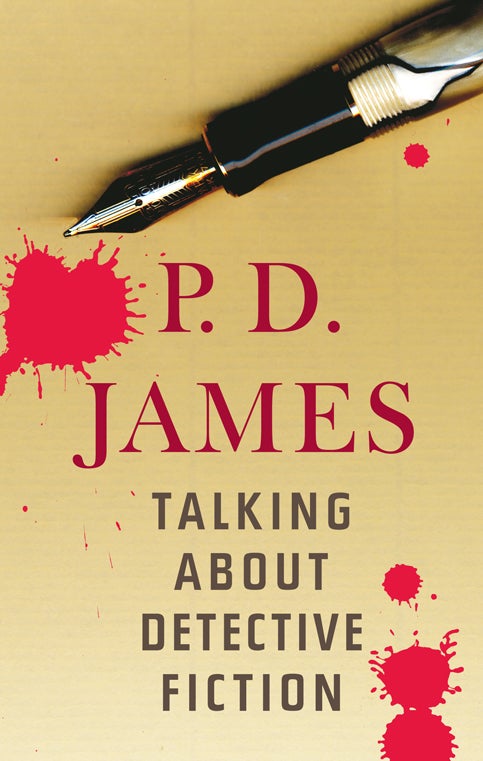
Review: Talking About Detective Fiction

In Talking About Detective Fiction, P.D. James deftly explores the history of detective novels in both Britain and America, and posits that contemporary unrest will lead to a renewal of interest in detective writing. James roots the genre in Wilkie Collins’ 1868 The Moonstone and traces its growth through the years, concentrating on the “The Golden Age” of detective writing – the period between the World Wars – and discussing the women writers she feels were instrumental in establishing the genre’s current reputation.

James is perhaps the best person to write a history of the genre that she’s been so prolific in, and she folds in her own writing experiences – important, since leaving out her own contributions would be an oversight. She does so casually, never making her work the focus of any one section, and explains why certain facets of the genre – such as never writing in first person, since that way readers only get one perspective of the case – work for her.

The most famous detective in literature, Sherlock Holmes, shares a chapter with G.K. Chesterton’s Father Brown, and James presents Holmes as the “unique, the unchallenged Great Detective, whose brilliant deductive intelligence could outwit any adversary, however cunning, and solve any puzzle, however bizarre.”

James discusses Arthur Conan Doyle’s publication history, and explores the relationship between Holmes and Watson, noting that the Watson prototype — “the stupid friend of the detective… should be slightly, but no more than slightly, less intelligent than the average reader, and his thoughts should not be concealed” — doesn’t appear in as many detective novels as he once did. (You should also go read this great article on Holmes’ London that appeared in the January issue of Smithsonian Magazine)

She also notes Agatha Christie’s popularity while downplaying her effect on detective novels:
Agatha Christie hasn’t in my view had a profound influence on the later development of the detective story. She wasn’t an innovative writer and had no interest exploring the possibilities of the genre. What she consistently provided is a strong and exciting narrative, the challenge of a puzzle, an accommodating and accessible style and original detectives in Poirot and Miss Marple, whom readers can encounter in book after book with the comfortable assurance that they are meeting old friends.
James later writes that “rereading a selection of her stories to affirm or modify my existing prejudices I found some lost even their ability to keep me reading. Others surprised me by being both better written and more ingeniously puzzling than I remembered." James prefers the work of writers like New Zealander Ngaio Marsh, who was deft at characterization.

After she presents Collins, Edgar Allan Poe and Conan Doyle as innovators, James traces how more contemporary authors have put their own spin on things – Dashiell Hammett and Raymond Chandler wrote hard-boiled novels with a distinctly American flavor, and Dorothy L. Sayers wrote about murder in a new, realistic way – but she fails to identify any detective novelist from the last 50 years who has had a profound influence on the genre. While science has demanded an update in the way detectives use DNA evidence, it hasn’t changed the way they locate suspects. Detective novelists may have updated and adapted the formula for their time and country, but no one has stormed in and upended the genre.

James believes that an interest in detective fiction is on the rise, as “its popularity suggests that in the twenty-first century, as in the past, many of us will continue to turn for relief, entertainment and mild intellectual challenge to these unpretentious celebrations of reason and order in our increasingly complex and disorderly world.”

Talking About Detective Fiction is a quick read and a nice, historical look at the genre for those who are familiar with it or want to know where to start. James doesn’t unearth anything new or groundbreaking, but she shows that despite the changes in technology, society and law enforcement in the last century, a quaintness remains in the detective novel, and it can survive because it offers a sense of comfort and escape for readers.

Friday, September 25, 2009

In the Attic with Frank Bruni

Frank Bruni, the former New York Times restaurant critic, is the author of Born Round: The Secret History of a Full-Time Eater, a wonderful and witty account of his lifelong struggle with his weight. He will be talking about his book with Times columnist Maureen Dowd at Politics and Prose in D.C. on September 29 at 7 p.m. Bruni and I talked last week for an article I wrote on him for the Washington Blade. Below is an edited transcript of the conversation.


What made you decide to put your story down in a book?

It sounds so simple, but I thought I had a story to tell. When I was offered the job of restaurant critic, there was a span of time when I was reflecting on how ironic it was to feel like I could do it. I remember thinking that if my wager is correct and being a restaurant critic doesn’t send me back to a really bad place in terms of bad eating an weight gain, then I should think about at some point writing this story.

I had read many food memoirs on the romance of eating, and I felt there was unmined territory in talking about overeating, which is a big part of a lot of people's lives. In my first year on the job, I would go out to eat with food writers and people connected to food as a profession in the restaurant industry, and people who lived foodie lives were among the most watchful, disciplined, careful eaters. They knew that being around food all the time, if they left themselves go, they would let themselves go. All of us write in such exultant and celebratory ways about eating, restaurants and food, and we coax people to come into restaurants. You have to be disciplined if you want to enjoy food without being undone by it, and I thought that was the book for me to write.

With the Internet making anonymous critiquing harder, and so many bloggers writing about restaurants, what do you think the future of restaurant criticism is?

The real danger to the future of conventional restaurant criticism is an economic danger. Restaurant criticism done the best way, by visiting a restaurant repeatedly, and trying to make a thorough survey of a menu is expensive. This is true for periodicals of any kind, print, online, whatever, to fund a restaurant critic's beat. The future is tied up in how institutions will be able to afford restaurant criticism in the way it should be done.

A lot of stuff on the Internet that is kind of expanding the universe of restaurant criticism isn't really restaurant criticism per se. I'm talking about user generated content on Citysearch or Yelp. You really have no idea who is rendering an opinion or what it's based on. It could be the shilling of a relative of the chef, or your don't know it you're reading someone who got a free comped meal, or you don't know if the person raving about a restaurant had two dishes or ten, or if they went one time or three.

People always ask food writers how they get to do what they do, and how it must be a dream job. Do you think it is?

Yeah, I think absolutely dream job but when you use that phrase for it, it includes the word 'job.' As soon as you make going out to eat a matter of obligation, as opposed to an option, it does take on aspects of being a job. You aren't going out to eat in a purely hedonistic pleasure driven way, you're making a scientific survey. Among those jobs we do, having your job be to go out and eat, sit in restaurants, which are often just wonderful places to be, bring along loved ones and friends to your table, among those things one must do in the course of a job, having to go out to eat is a pleasant one.

You talk in the book about how you've never been much of a cook. Have you been able to improve at all?

I'm just kind of making that effort now. I've never been much of a cook, and in the last five and a half years I haven't improved because I haven't had the occasion to cook. I've been eating out seven nights a week, and if it wasn't seven nights, it was six nights, and on the off night I didn't want dinner to be a long thing that involved lots of cooking, but a quick thing. I have a great appreciation for what makes great food than I did five and a half years ago, and I'm improved over time with exposure to more and more great food.

There are a lot of cities that have great food reputations. What are some off the beaten path cities that you've enjoyed eating in?

I keep wishing I could spend more time in Austin. There's really good, casual Tex Mex, and a couple restaurants that don't get an enormous amount of attention. One is called Hudson's on the Bend, and they serve an array of exotic game, and the other is Fonda San Miguel, which does Mexican food at a level it's not usually done at. They go way beyond guacamole.

You've written about so many different topics for newspapers. Is there one in particular that you find most fulfilling?

It's the variety itself I really like. My little brother has teased me that I don't have a career, I have attention deficient disorder. Journalistically that's correct, and to me the great opportunity and joy of journalism is being able to get into and ping between so many different worlds. I'm lucky enough to be a quick enough study and quick enough writer that I've been able to do that. I think if I had to write about one topic, it would be difficult for me.

So you're going to be writing for the Times magazine next? What are some topics you'd like to cover?

I'm going to be a committed dilettante at the magazine. The job enables me to cover the things I've been interested in over a long span of time — culture, politics, and food, based on what story presents itself at a given time.

Photo credit: Soo-Jeong Kang

Sunday, August 30, 2009

Believer Book of Writers Talking to Writers

While there may be many right times to read a certain book, there are also many wrong times as well. When I was back home this month, I came across the Believer Book of Writers Talking to Writers (2005), which I got over three years ago and has sat unread on my shelf ever since. I didn't bring it to D.C. with me, as I brought some other unread books, perhaps knowing instinctively that it was not yet the right time for me to read the book. It contains 23 conversations between writers and the writers they admire, some which were published in the Believer magazine (which I used to subscribe to), others which were previously unpublished.

But now was the right time, because if I had read it any sooner, I wouldn't have read books by some of the authors interviewed (Haruki Murakami, Zadie Smith, Jamaica Kincaid), and I wouldn't have heard of many of the other writers mentioned in the interviews. I wouldn't have been contemplating/rethinking my job as a journalist, and wondering if it is really the best use to my abilities. I wouldn't have been writing fiction again and been able to benefit from the abundant advice that the writers inexplicitly offer in these pages. In short, if I read the book when I first got it, I wouldn't have gotten any semblance of what I got out of it when I read it this month.

This has happened before — with a number of "classic" books that I read in high school, (especially To Kill a Mockingbird and The Great Gatsby), first readings proved underwhelming, while subsequent readings were enlightening. It also makes me wonder what other books I simply read at the wrong time. I hated A Confederacy of Dunces, but maybe I was just in a mercurial mood.

But back to Writers Talking to Writers. From John Banville being interviewed by Ben Ehrenreich on what qualifies as literature:
I suppose I would say that it must have a quality of the transcendent. I do not mean metaphysical transcendence, but a kind of heightening. In the work of art, the world is made for a moment radiant, more than itself while at the same time remaining absolutely, fundamentally, mundanely, utterly itself.
to Marilynne Robinson on Herman Melville's use of metaphor:
The method of Melville is just opening, opening, opening. He sees something, he transforms it metaphorically, he in a sense takes in from it what can be comprehended, what the fabric has allowed him, and then he feels the insufficiency of the thought. So the process begins again… One of the things that it does is make demands on language that language is almost uncannily capable of meeting, demands that are almost never made under any other circumstances.
and Robinson later on writers' abilities with characterization — "it comes nowhere near capturing the actual experience. When you are with somebody you love, that seems as it ought to be. But when they're absent from you, you are more aware of them because of their absence. Loss can create a more profound presence than presence itself,"

the interviewers/writers extract insightful thoughts and engage in wholly compelling discussions on literature and the act of writing.

But it's not all serious —we learn that James Salter laments the passing of an age ("I miss letters, ocean liners, New York when you could drive anywhere and park, and I miss the indifference that once existed toward popular culture"), that Joan Didion re-reads Joseph Conrad's Victory anytime she starts writing a novel, and that the same novel (which I have not read, but just bought this morning at Capitol Hill Books) "travels with" Shirley Hazzard.

I eat this stuff up — whenever I'm really taken with a work, I read as much about the author as I can — interviews, biographies, sometimes other works — because for me it grounds the book in such a way that I get much more out of it and develop a greater appreciation for what the author is doing. I'm glad I wasn't studying literature when new criticism was in vogue. The 2008 version mixes up the interviews, and includes one with David Foster Wallace, so I might have to track that one down.